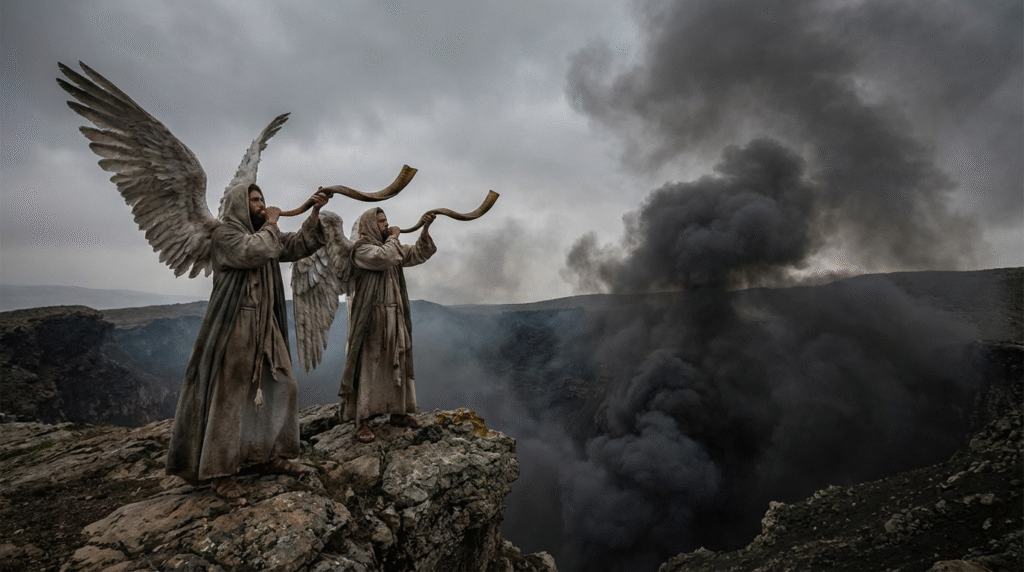

Revelation can feel like standing in a storm with a map you have not learned to read yet. Still, God did not give John’s visions to confuse believers, but to steady them.
This Revelation 11 explained guide (NKJV) walks through the measured temple, the Two Witnesses, the Beast, and the turning point of the seventh trumpet. Just as important, it shows how these scenes shape a calm, faithful posture when pressure rises.
From Revelation 4 onward, John records a forward-moving sequence of events. Chapter 11 sits right in the middle of that flow, like a breath between thunderclaps.
Where Revelation 11 fits in John’s end-times timeline (Dispensational view)
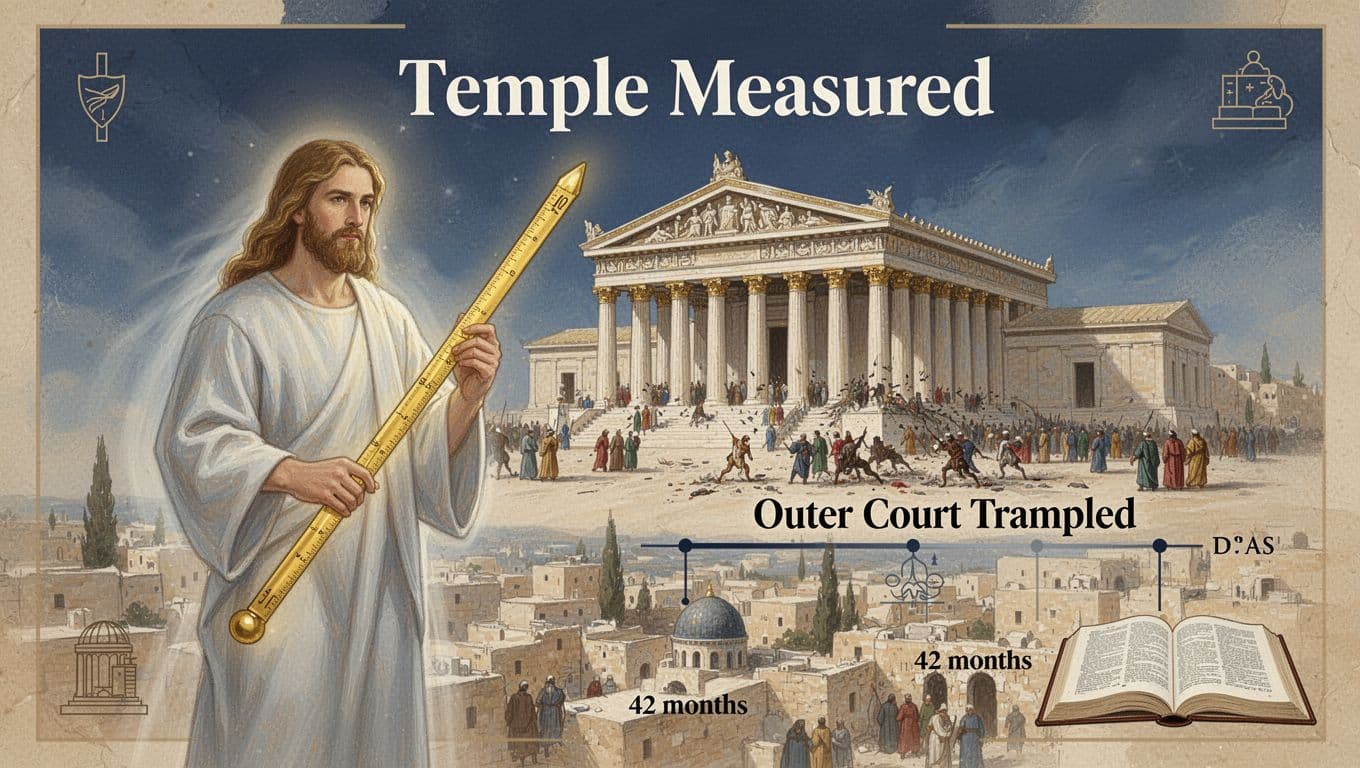
An AI-created infographic showing the measured temple and the 42-month time marker in Revelation 11.
Revelation 11 comes during the trumpet judgments, after the sixth trumpet and before the seventh. That matters because it reads like an interlude, yet it still advances the storyline. In other words, God pauses the action to show what He is doing in Jerusalem while the world shakes.
John is told to measure the Temple of God, the altar, and the worshipers with a measuring rod (NKJV, Rev. 11:1). However, the outer court is excluded because the nations tread the holy city underfoot for Forty-two months (Rev. 11:2). In a dispensational framework, that time marker lines up with the second half of Daniel’s 70th week (often called the Great Tribulation, triggered by the Abomination of desolation), a focused period of global pressure and Jewish-centered events.
The measuring itself carries a simple message: God marks off what belongs to Him. Measuring is not just about size. It signals ownership, protection, and accountability. At the same time, the outer court being “given” to the nations shows permitted suffering within set limits. God sets boundaries, even when evil looks loud.
When the Lord measures, He’s saying, “This is Mine,” even if the street outside feels out of control.
This also points to a real, future temple setting in Jerusalem within the narrative, tied to the Antichrist’s desecration. Revelation 11 does not feel like a vague symbol. It reads like a location where worship, sacrifice language, and a specific city matter.
The Two Witnesses in Revelation 11 (NKJV): their message and authority
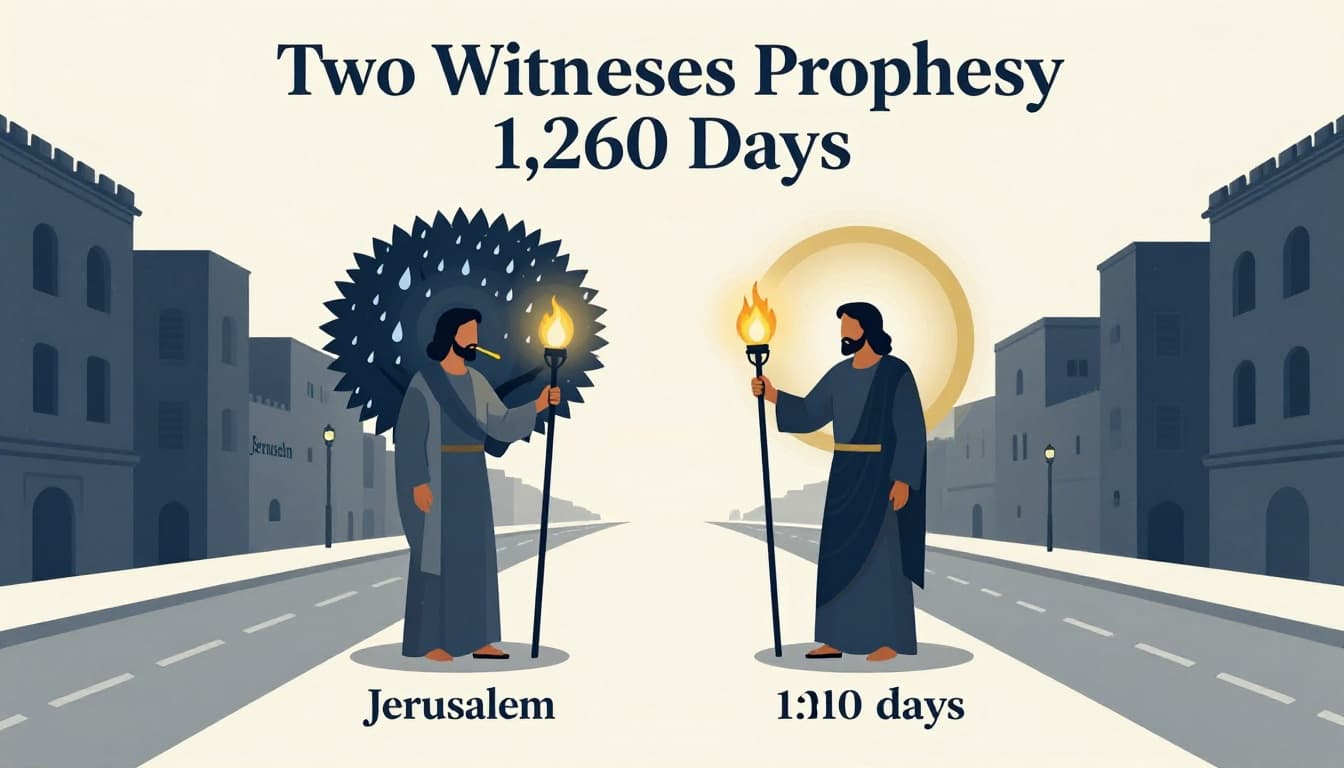
An AI-created infographic depicting the Two Witnesses and their 1,260-day ministry in Jerusalem.
Next, John sees two witnesses who “prophesy one thousand two hundred and sixty days, clothed in sackcloth” (Rev. 11:3). That is the same window expressed another way: 1,260 days equals 42 months (using 30-day months, common in prophetic calendars). The text calls them “the two olive trees and the two lampstands” (Rev. 11:4), echoing imagery from Zechariah 4. The picture suggests a Holy Spirit-empowered testimony that burns steadily, like a lamp that will not go out.
Their authority is striking. Fire from their mouth devours their enemies, they can strike the earth with plagues, turn water to blood, and shut up the sky so rain does not fall (Rev. 11:5-6). Those details remind readers of Elijah and Moses, so many teachers connect the Two Witnesses to Moses and Elijah. Others suggest Elijah and Enoch, since both left earth in unusual ways. Revelation 11 does not name them, so it is wise to hold identity theories with an open hand while keeping the main point in a tight grip: God appoints, empowers, and protects His messengers until their assignment ends.
Their ministry is also public. It happens in “the great city” where the Lord was crucified (Rev. 11:8), pointing plainly to Jerusalem. This is not a hidden corner of the world. It is center stage.
If you follow a Christian Seer or value prophetic insight, Revelation 11 offers a guardrail: prophecy is not given for obsession, but for faithful witness. The Two Witnesses do not entertain crowds. They prophesy, call people to God, and endure hatred.
The Beast from the Abyss: the counter-kingdom’s answer to testimony
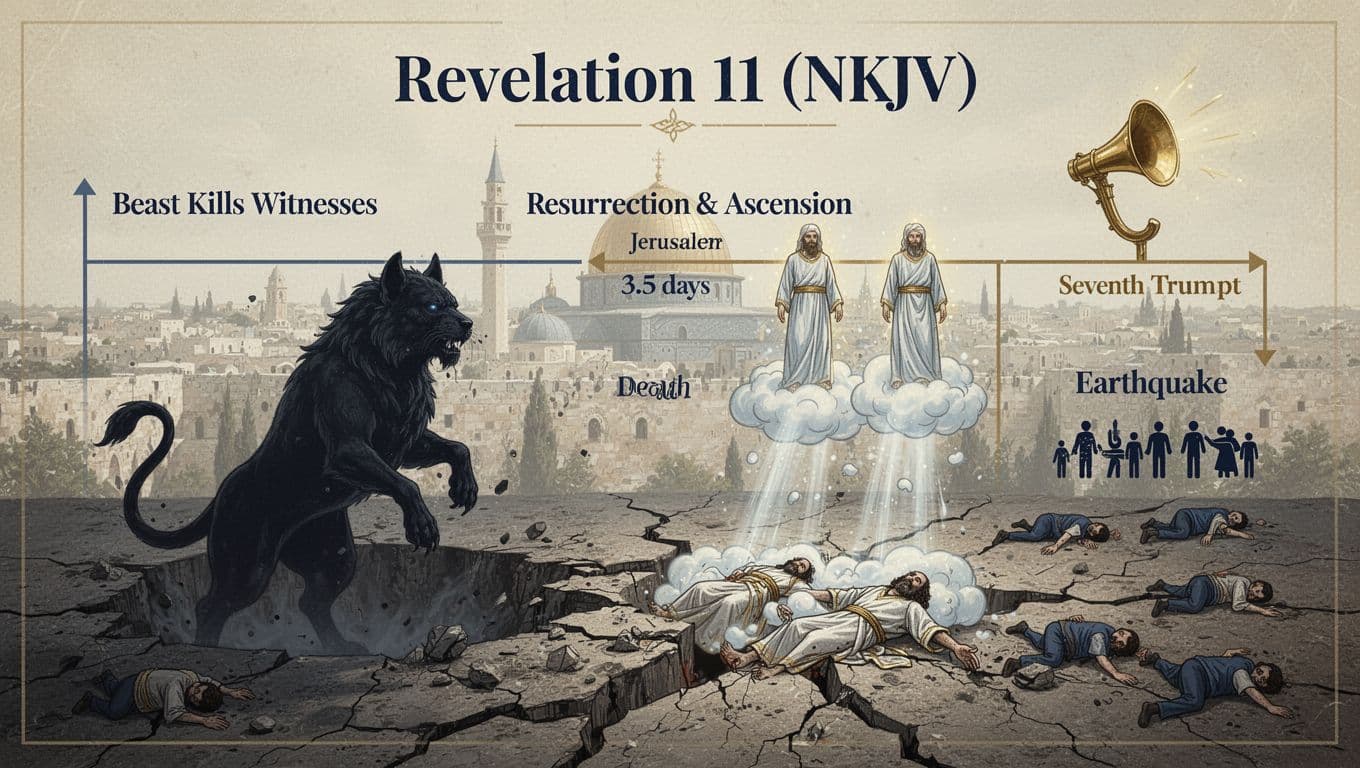
An AI-created infographic summarizing the Beast’s attack, the witnesses’ resurrection, and the earthquake in Jerusalem.
Revelation 11 introduces a new level of opposition: The Beast that ascends out of the bottomless pit makes war against the witnesses and kills them (Rev. 11:7). In dispensational teaching, The Beast connects with the Antichrist’s rise, along with his alliance with the False prophet, and the strengthening of his global control (developed further in Revelation 13).
Notice the timing. The Beast cannot touch them until they “finish their testimony” (Rev. 11:7). That line does not remove grief, but it does place a limit on evil. God permits conflict, yet He never loses the schedule.
Then comes a chilling scene without graphic detail. Their bodies lie in the street of the great city, figuratively called Sodom and Egypt, for three and a half days while the world celebrates (Rev. 11:9-10). The reaction exposes something ugly: when people hate God’s voice, silence feels like a holiday.
After three and a half days, “the breath of life from God” enters them, sparking their resurrection; they stand, and they ascend (Rev. 11:11-12). Immediately, a great earthquake follows, and many are killed (Rev. 11:13). The survivors become “afraid” and give glory to God, which signals a real shock to the world’s confidence.
The Beast can stage a celebration, but he can’t stop resurrection life.
The chapter ends with a transition: the seventh trumpet arrives (Rev. 11:15). That seventh trumpet points toward the final sweep of judgments and the public claim that “the kingdoms of this world” belong to the Lord and His Christ, following the testimony the witnesses completed.
Stay steady under pressure when Revelation 11 feels heavy
Revelation 11 is not only about future events. It also trains believers to endure hard days with clear eyes. Pressure exposes what we trust.
First, let God “measure” your life. The reed in John’s hand is a picture of God’s standards. So, return often to Scripture, confession, and obedience. When life feels loud, simple faithfulness keeps you anchored.
Second, treat your witness like a long obedience, not a quick speech. The Two Witnesses prophesy for 1,260 days. That is patient, daily Testimony. In the same way, a prophetic mindset is not constant prediction. It is steady alignment with God’s truth, even when it costs you.
Third, expect pushback in the end times, but don’t let it make you harsh. Revelation 11 shows real hostility, yet God’s people still speak with purpose. If you want a practical path, keep it basic:
- Stay close to God and the Holy Spirit in prayer because fear shrinks when you speak to the Father.
- Keep your words clean because pressure tempts us to sin with the tongue.
- Hold tight to Christian community because isolation makes every trial feel bigger.
- Remember the Forty-two months of trampling because it is a set limit that encourages endurance, along with 3.5 days preaching restraint on evil.
Finally, keep resurrection in view. The witnesses’ story teaches that apparent defeat can be temporary. God’s last word is not mockery in the street, but life from heaven.
Conclusion: Revelation 11 points to God’s control, not our panic
Revelation 11 (NKJV) shows measured boundaries, faithful witnesses, a raging Beast, a God who raises the dead, and the Ark of the Covenant appearing in the temple, events that precede the Second Coming of Christ. That is not a script for fear, it is fuel for endurance. If you’re tracking John’s visions from Revelation 4 through 22, let this chapter reset your confidence: God rules the clock and the outcome. Stay ready, stay humble, and keep your testimony steady under pressure.