Picture John on the island of Patmos, caught up in a vision that feels both holy and heavy. In Revelation 6 (NKJV), he watches the Lamb open the first seal, and the scene moves fast. A rider appears, a horse flashes white, and a chain of events begins that many believers connect with end-times turmoil.
The “white horse of the apocalypse” is easy to misunderstand because white often signals purity in Scripture. Yet Revelation asks us to read by context, not by color alone. This article follows a dispensational framework and stays close to what the text says, why it matters, and how to respond with steady faith, not panic.
What John actually sees when the first seal is opened
Revelation 6 starts with the Lamb (Jesus) opening the seals of a scroll. John isn’t watching random chaos; he’s watching God’s ordered plan unfold. When the first seal is opened, John sees the first rider appear.
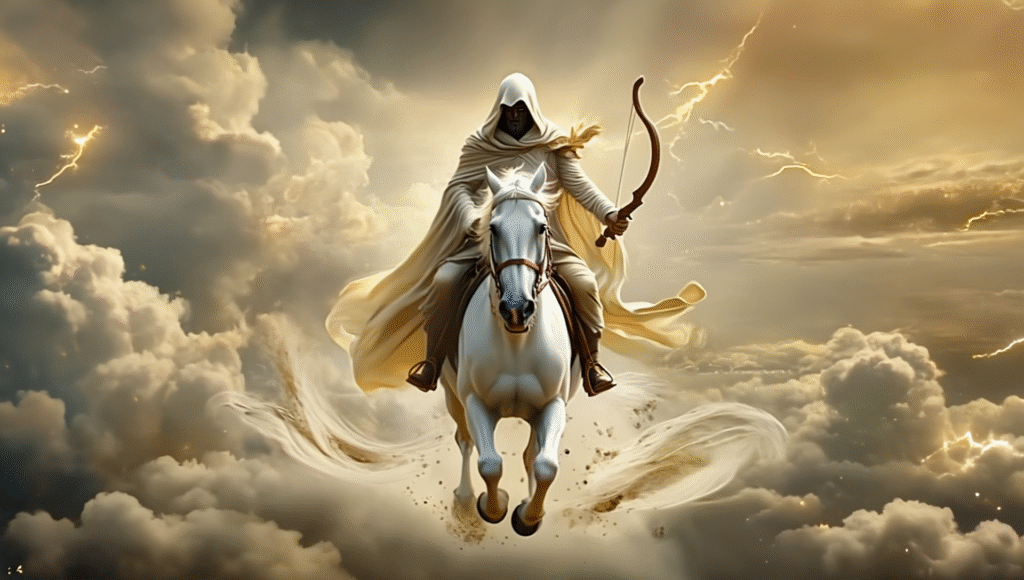
Revelation 6:2 (NKJV) gives the core snapshot: “And I looked, and behold, a white horse. He who sat on it had a bow; and a crown was given to him, and he went out conquering and to conquer.” That’s the first seal in one verse: a white horse, a rider with a bow, a crown that is given, and a clear mission of conquest.
A simple observation helps here: the rider is active, but he’s not described as speaking. He doesn’t announce a name or a claim. The text also doesn’t describe him as holy, faithful, or true. John reports what he sees, and the Spirit expects us to notice the details before we label the rider.
The first seal matters because it sets a tone. Revelation doesn’t begin with the worst scenes first. It begins with a figure who looks impressive, even hopeful at a glance, then the later seals darken into war, famine, and death. That sequence is part of the warning.
The key details people miss: bow, crown, and conquering
Three small details carry a lot of weight.
First, the rider has a bow, but Revelation 6:2 doesn’t mention arrows. Some readers see that as a hint of conquest by threat, pressure, or show of force rather than open battle. The text itself doesn’t explain the missing arrows, so it’s wise to hold that point with an open hand, but still notice it.
Second, “a crown was given to him.” The wording matters. This rider receives authority. It’s not presented as his by nature. In Revelation, that “given” language often points to permission within God’s bounds. The rider is not outside God’s control, even if he becomes a tool of judgment.
Third, he goes out “conquering and to conquer.” That is a steady, focused push for dominance. Not a single victory, but a campaign.
And what about the white horse itself? White can signal righteousness in Revelation, but white can also function as a convincing cover. Context decides. When the first seal rider appears without the clear identifiers that belong to Christ, the color alone can’t settle the question.
How this white horse differs from Jesus on a white horse later in Revelation
A big mistake is assuming every white horse in Revelation carries the same rider. Revelation 6 and Revelation 19 describe two very different scenes.
In Revelation 19, Jesus appears openly as the returning King. He is named, titled, and described in ways that leave no doubt. The outcomes are also different. The first seal rider goes out to conquer across the earth. Christ returns to end the rebellion and rule in righteousness.
Here’s a simple comparison that helps keep the passages separate:
| Feature | Revelation 6 (First Seal) | Revelation 19 (Christ’s Return) |
|---|---|---|
| Timing | Early in the seals | After major judgments, near the end |
| Rider’s identity | Not named | Called Faithful and True |
| Weapon | Bow (arrows not mentioned) | Sword from His mouth (His word) |
| Authority | “A crown was given” | Many crowns, rightful rule |
| Result | Conquest that precedes worse seals | Final victory and judgment |
Not every “white horse” points to Jesus. Revelation itself shows that similar symbols can carry different meanings depending on the moment.
Is the rider on the white horse the antichrist? The case many dispensational teachers make
Within dispensational teaching, a common view is that the first seal rider represents the antichrist, or at least the antichrist’s rising system and spirit of deception. The logic usually runs like this: the first rider looks compelling, he gains authority quickly, and his conquest seems to come before open war. That fits the idea of a charismatic leader who unifies, negotiates, and gains control before the world sees the cost.
Scripture describes an end-times figure who opposes Christ and exalts himself (compare 2 Thessalonians 2). Revelation later speaks of the beast’s rise and global influence. Dispensational readers often connect those dots and see the first seal as the opening move of that rise.
It’s important to keep the claim in the right place. Revelation 6:2 doesn’t use the word “antichrist.” So we don’t need to speak with more certainty than the text gives. Still, the themes of delegated authority, conquest, and the timing before the tribulation judgments intensify make this interpretation persuasive for many.
Why “a crown was given” points to delegated authority
That short phrase “a crown was given to him” is one reason dispensational teachers lean toward an antichrist connection. The rider receives the right to rule, at least for a time. It suggests permission, not inherent kingship.
In plain terms, this looks like someone who gains power through systems, agreements, and global acceptance. His authority feels official and even celebrated. People may praise him as the answer to conflict, fear, or economic strain.
That’s how deception often works. It doesn’t show up wearing a warning label. It shows up looking like relief. The white horse image can fit that pattern, a figure presented as a solution, while the later seals reveal what the “solution” was really building toward.

How the first seal sets the pace for the tribulation
The seals don’t stand alone. They move like falling dominoes. The first seal is followed by riders tied to war, scarcity, and widespread death (Revelation 6:3-8). A dispensational timeline often places these seals within the early part of the tribulation period, with escalating judgments as the seals, trumpets, and bowls unfold.
If the first rider represents deceptive conquest, it explains the flow. False peace and rapid consolidation can create the conditions for later conflict. When control tightens, resistance grows. When promises fail, people panic. Revelation’s sequence reads like a world being squeezed until it breaks.
So, even if someone hesitates to label the rider as the antichrist with certainty, the first seal still signals a shift: a season where conquest begins, and everything after it gets harsher.
How the white horse fits into the bigger story of the tribulation
Revelation gives a broad structure that helps readers stay oriented. Many dispensational teachers describe the judgments in three main waves: seals, then trumpets, then bowls. You don’t need a chart to benefit from that structure. It simply shows that God’s judgments intensify in stages, and the first seal is the start of the first stage.
In that big picture, the white horse appears at the front door of the tribulation story. It’s not the end of the world in one moment. It’s the beginning of a process where control, conflict, and collapse unfold in sequence.
One reason the white horse is so discussed is that conquest doesn’t always look like tanks rolling in. Conquest can look like treaties, strong alliances, promises of safety, and a leader who seems to fix what others couldn’t. The rider’s bow and crown fit a picture of power gaining ground quickly, while still leaving room for the next seals to bring open war and suffering.
This is also why the passage hits home in every era. People recognize the pattern: a strong figure rises, many celebrate, critics are silenced, and then the cost shows up later.
From conquering to chaos: what follows after the white horse rides
Revelation 6 doesn’t let the reader sit long with the first rider. The second seal brings a red horse tied to taking peace from the earth. The third brings scarcity and economic strain. The fourth brings death on a wide scale. The order matters, because it reads like cause and effect.
A push for conquest often produces backlash. Backlash leads to war. War strains food supply and trade. Scarcity weakens nations. Weak nations face disease, violence, and breakdown. Revelation shows the spiritual root behind the headlines, but the outcomes still look painfully human.
That’s why the white horse shouldn’t be treated as a side curiosity. If the first seal is the opening act, it shapes how we read everything that follows. It warns that the early stages may look clean and controlled, even “successful,” right before the slide into chaos becomes obvious.
What this passage is not trying to do (and why date-setting fails)
Revelation 6 is not a puzzle meant to fuel obsession. It’s prophecy meant to produce faithfulness. When people try to pin the first seal to a specific headline or set a date for the end, they usually end up harming their own peace and confusing others.
Date-setting fails for a simple reason: Scripture calls believers to watch and be ready, not to predict the day and hour. Readiness is a posture, not a calculator.
A steady approach looks like this: keep Revelation in its context, compare Scripture with Scripture, and refuse fear-based teaching. The book of Revelation was given to strengthen believers under pressure. If a teaching leaves you frantic, suspicious of everyone, and glued to rumor, it’s missing the point.
What believers can do with this today: discernment, hope, and steady faith
The white horse, the antichrist theme, and the tribulation timeline can feel intense. Yet Revelation was written to churches, to real people with jobs, families, and burdens. God didn’t give prophecy to steal our sleep. He gave it to anchor our hope.
A dispensational reading highlights that Jesus will fulfill His promises in history, not just in ideas. That should steady the heart. The Lamb opens the seals. Evil is not free-range. Even when deception rises, it rises on a leash.
So what do we do with Revelation 6 in February 2026, with all the noise and anxiety around us? We practice discernment, we hold to Christ, and we live faithfully in the day we’ve been given.
Discernment in an age of “almost true” messages
Deception rarely sounds like obvious evil. Often it sounds like truth with something missing. It may use Bible words while twisting Bible meaning. Or it may praise peace while rejecting the Prince of Peace.
A helpful test is simple: does the message match the plain sense of Scripture, the character of Christ, and the fruit of the Spirit? The first seal rider rides out to conquer. Conquest can tempt people to excuse lies for the sake of “results.” Believers can’t afford that trade.
Stay close to the Gospels. Keep Revelation connected to the whole Bible. When someone claims secret knowledge, special dates, or fear-driven certainty, treat that as a warning sign, not a badge of insight.
A grounded response: watchful, not worried
Watchfulness is active, not anxious. It’s the difference between a guard at the gate and a person pacing the floor all night.
Here’s what watchful faith can look like in real life:
- Stay in the Word each week, not just in prophecy passages.
- Pray for wisdom and a calm mind, ask God to guard you from fear.
- Live faithfully in your work, your home, and your relationships.
- Share the gospel with kindness, urgency doesn’t require pressure.
- Stay connected to a healthy church community and wise counsel.
The goal isn’t to crack every symbol. The goal is to follow Jesus with a steady heart. If the first seal warns about deception, then simple obedience becomes a form of spiritual resistance.
Conclusion
The first seal in Revelation 6 (NKJV) shows John a rider on a white horse with a bow, a crown that is given, and a mission to conquer. Many dispensational teachers connect this rider to the rise of the antichrist, or to the system of deceptive power that prepares the way for the tribulation judgments that follow. Whether you hold that identification with firm confidence or careful caution, the passage still calls for discernment, readiness, and calm trust.
You don’t need to live in fear of Revelation. The Lamb opens the seals, and Jesus returns in victory. Hold tight to Christ, stay rooted in Scripture, and keep studying Revelation with humility and faith.