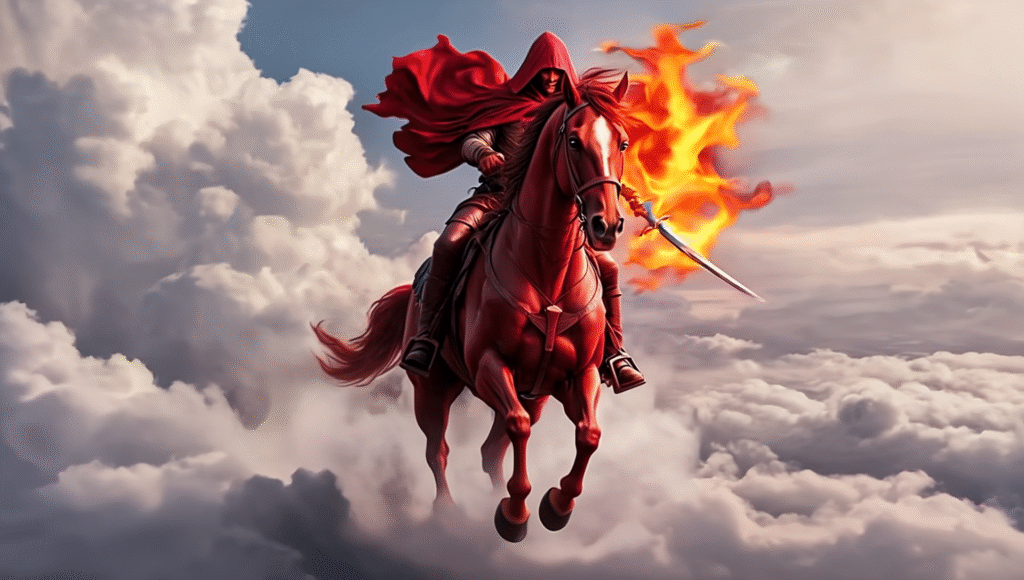
Picture the scene John describes in Revelation: heaven is not noisy or frantic, it’s ordered. A scroll is present, sealed tight, and only the Lamb is worthy to open it. When the Lamb opens the second seal, John doesn’t see a chart or a timeline, he sees a horse, a rider, and a world where peace is pulled away.
In the NKJV, the moment is simple and sobering. The Lamb opens the seal, a voice calls “Come and see,” and a fiery red horse goes out. The rider is granted power, and the result is heartbreakingly clear: people turn on each other.
This matters because Revelation wasn’t given to paralyze believers with fear. It was given to steady them. Let’s look closely at what the red horse means, how it fits the tribulation in a dispensational reading, and how Christians can live with calm trust when the world feels anything but calm.
What the Bible actually says about the red horse and the second seal
Revelation 6 moves with a firm rhythm: the Lamb opens a seal, heaven responds, and earth feels the impact. When the Lamb opens the second seal, John writes that the second living creature says, “Come and see.” Then “another horse, fiery red, went out” (Revelation 6:3-4, NKJV).
The focus is not on the horse by itself, but on what is given to the rider. The text says the rider “was granted to take peace from the earth, and that people should kill one another; and there was given to him a great sword” (NKJV). That’s the whole picture, and it’s enough to understand the message without chasing wild theories.
A few details are easy to miss if you read too fast:
- The Lamb opens the seal. Judgment is not random, and history is not spinning out of God’s hands.
- Peace is taken “from the earth.” This is wide in scope, not limited to one city or one battlefield.
- The result is personal and brutal: “people should kill one another.” It isn’t only soldiers in uniform. It’s violence spilling into human life.
- The rider receives “a great sword.” The passage doesn’t say he forges it. It is handed to him, meaning authority is permitted for a time.
In a dispensational understanding, this seal is part of the early sequence of end-time judgments that unfold during the tribulation. The red horse is not presented as a riddle for proud minds, but as a warning that peace on earth is more fragile than most people admit.
The main symbols in the passage, the red horse, the rider, and the great sword
Revelation uses signs the way a storm warning uses dark clouds. You’re meant to grasp the danger, not admire the artwork. The red horse is “fiery red” in the NKJV, a color most readers connect with bloodshed, war, and the cost of human anger turned loose.
The rider matters because he isn’t described with a name or a nation. That keeps the emphasis on what he represents: a force of conflict allowed to spread. Most importantly, the rider’s power “was granted.” That phrase keeps showing up around God’s judgments in Revelation. Evil acts, but it never becomes king. God remains King.
The “great sword” points to violence and authority to harm. In Scripture, a sword can represent judgment, war, and the power to take life. Here, it fits the plain outcome of the seal: people killing one another. The sword is not described as small or hidden. It’s “great,” open and terrifying.
A quick summary helps keep the symbols tied to the text:
| Symbol in Revelation 6:3-4 (NKJV) | What John sees | Basic meaning in context |
|---|---|---|
| Fiery red horse | A red horse going out | Bloodshed and widespread conflict |
| The rider | Given authority | A permitted agent of unrest |
| Great sword | Given to the rider | Power to bring violence |
This is not meant to make believers obsessed. It’s meant to make believers awake.
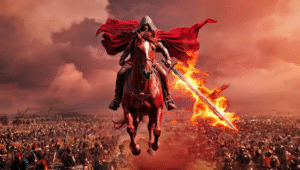
What “taking peace from the earth” can look like during the tribulation
The words “take peace from the earth” are short, but they cover a lot of ground. Peace is more than the absence of bombs. Peace is social trust, stable laws, and a sense that tomorrow will still hold together. When that is taken, people don’t just disagree, they fracture.
Revelation 6:4 says the result is that “people should kill one another.” That sounds like conflict that spreads sideways through society, not only front lines between armies. During the tribulation, as the seals open in sequence, the Bible presents an escalating storm of judgment and distress. The red horse fits that rising pattern.
Without forcing today’s headlines into the passage, it’s not hard to imagine the kinds of conditions that match the text’s plain meaning: wars between nations, civil unrest, local violence, breakdowns in public order, and communities turning suspicious and harsh. Peace can be removed in boardrooms and streets at the same time. It can vanish through fear, propaganda, shortages, and raw rage.
At the same time, Revelation doesn’t call Christians to guess dates or map every event. It calls Christians to remember that God sees the whole field, even when people only see smoke.
How the red horse fits into a dispensational timeline of the tribulation
Many Christians who hold a dispensational view read Revelation’s judgments in a broad sequence: seals, then trumpets, then bowls. In that framework, the seals mark early developments in the tribulation, setting the stage for greater troubles that follow.
The red horse appears at the second seal, so it comes early in that unfolding period. It’s not the final crisis, but it is a major shift: peace is removed, and violence multiplies. If the first seal brings a kind of conquest or dominating power, the second seal shows what happens next when restraint gives way.
Dispensational teachers often connect these judgments with Daniel’s seventieth week and with Jesus’ teaching about birth pains (Matthew 24). Birth pains start, intensify, and come closer together. In that sense, the red horse doesn’t stand alone as an isolated disaster. It’s part of a progression where the world’s false confidence collapses step by step.
It’s also important to keep the tone right. Revelation is honest about suffering, but it’s not written to crush hope. The Lamb is opening the seals. That means the same Jesus who died and rose again is governing the process. The tribulation is real, but it is not uncontrolled. God is not watching from a distance. He is acting with purpose, even in judgment.
A simple way to see the first and second seals working together
A lot of readers find the seals easier to grasp when they are viewed as a sequence of cause and effect. While faithful Christians differ on details, a common dispensational approach sees a clear progression:
The first seal (the white horse) is often taught as a period of conquest, dominance, or deceptive peace, sometimes through diplomacy and promises that look hopeful on the surface. Things can look “managed” for a moment, like a polished lid over boiling water.
Then comes the second seal, the red horse, and the illusion breaks. The text does not say peace fades. It says peace is taken. That implies an active removal of restraint. It’s like pulling the last brick from a shaky wall. What was held back now spills out.
This pairing also guards us from a shallow reading of “peace.” A world can have treaties and still be full of hatred. A world can have public calm and still be ready to snap. The second seal shows what happens when the inner violence of the human heart is no longer checked in the same way.
Where the antichrist discussion usually comes in, and why the second seal still stands on its own
The antichrist often enters the conversation when people talk about the opening phase of the tribulation. Many dispensational teachers link the first seal’s rider to the antichrist, seeing a rise to power that looks impressive and persuasive. Others disagree and see the first rider differently.
Either way, the second seal does not depend on solving every question about the first rider’s identity. The red horse message is clear on its own terms: peace collapses, and violence spreads, because authority “was granted” for it to happen for a time.
That’s also a helpful anchor for readers who feel overwhelmed by prophecy charts. You can respect careful study while still holding tight to what the text plainly says. The second seal warns that a future season will feature large-scale conflict and mutual slaughter. It also quietly reminds you that even then, nothing outruns God’s rule.
If you’re reading Revelation and feeling your stomach tighten, pause and notice who is in control of the seals. It isn’t the antichrist. It’s the Lamb.
What the red horse teaches Christians today, steady hearts in a violent world
It’s tempting to read the red horse and then scan the news for matching shapes. Revelation will not reward that habit. It will feed anxiety, and anxiety rarely produces wisdom. A better approach is to let the passage do what God intended: sober us, steady us, and point us back to Christ.
The red horse shows what happens when peace is removed, but it also shows that judgment happens under authority. Evil is real, and spiritual conflict is real, but neither one is ultimate. The rider is not “crowned” here. He is “granted” permission. That difference is everything.
For believers, this has two practical effects. First, it keeps us honest about the world. Human nature, apart from God’s restraint and grace, does not drift toward peace on its own. Second, it keeps us hopeful. If the Lamb opens the seal, then the Lamb also holds the ending.
Revelation was written to strengthen endurance. It calls Christians to worship, to stay faithful under pressure, and to keep the testimony of Jesus. The red horse is not a prompt to hoard supplies and harden your heart. It’s a prompt to live ready, love your neighbor, and keep your hands open to serve.
God is still on the throne, even when peace is taken
The most comforting detail in Revelation 6 is easy to overlook: the Lamb initiates the action. The second seal does not open because chaos breaks heaven’s locks. It opens because Christ permits a judgment that fits God’s plan.
That doesn’t make the suffering less painful. It does keep suffering from being meaningless. When peace is taken, many people will feel abandoned. Revelation pushes against that feeling. The throne is not empty.
If fear has been loud in your life, this passage offers a quiet correction. Fear doesn’t get the final word. Christ does. The same Savior who holds history also holds His people, and He won’t lose a single one who belongs to Him.
Practical ways to live with faith, watchfulness, and compassion
Living in light of the red horse doesn’t mean living tense. It means living awake. Start with steady habits that build courage over time: stay close to Scripture, pray for peace and for leaders, refuse hatred even when it’s popular, support those who suffer, practice generosity, share the gospel with patience, and keep your eyes on Jesus when others are staring at rumors.
These are not dramatic moves, but they are strong ones. They also match the purpose of Revelation, which is not to entertain curiosity, but to strengthen believers to endure with clean hands and a clear witness.
If someone around you is frightened by end-times talk, be the calm person in the room. Speak about the Lamb more than the horse. The red horse is real, but so is the promise that God will make all things new.
Conclusion
The red horse of the apocalypse appears when the Lamb opens the second seal in Revelation 6:3-4 (NKJV). In simple terms, it pictures peace being taken from the earth and violence spreading so widely that people kill one another, and a great sword is given to the rider. In a dispensational view of the tribulation, this seal fits early in a series of judgments that intensify over time, whether or not you place the antichrist in the first seal.
The steadying truth is the same either way: the Lamb opens the seals, and nothing happens outside God’s permission. Hold that close when the world feels unstable. Trust Jesus Christ, ask for wisdom, and live ready with faith and compassion.